
Agentic apps from day one
ACRYL, the IDE that writes its own plugins, and ACRYL Blends, the framework it is built with.
ownMyAI · Vienna · 20 October 2026 · acryl.dev
Tuesday 20 October 2026 · 18:00 to 21:00
IT-Services der Sozialversicherung, Johann-Böhm-Platz 1, 1020 Wien
luma.com/2mxma8s0
A new kind of software: composable software 2.0, agentic from day one
It writes itself
Ask for a feature and the agent inside builds it as a plugin, live, while you keep working.
It repairs itself
The agent tests what it built, finds what is wrong and fixes it; a broken plugin is reverted without a trace.
It adapts to its use
Two people start from the same app and end up with two different apps, each shaped by how they work.
It is made of parts
Small plugins you can add, swap, remove, version, share and reuse, so nothing has to be rebuilt from zero.
And it is yours: it runs on your machine, with your data, from files you can commit to your own git.
The SaaSpocalypse
When agents write code, any product that is not agentic can be copied, rebuilt cheaper, or open-sourced.
Features are no longer a moat
A competitor's agent rebuilds your feature list in a weekend.
Fixed software ages instantly
Every user wants it slightly different; a fixed product serves the average user, and no one exactly.
What stays valuable
Software that keeps evolving with each user, with an agent inside that knows the app and grows it.
Cordis
The plugin kernel under DeepSeek Harness, and under everything in ACRYL.
A kernel that grew up in chatbots
- Koishi: a cross-platform chatbot framework (Discord, Telegram, Matrix and more) with 4,000+ community plugins
- Cordis (2022): its plugin kernel, extracted as a meta-framework. It knows nothing about LLMs, agents or tools
- DeepSeek Harness forked it (
@deepseek-ai/cordis) and built the agent on top: model adapters, tools, sessions, sandboxes, the UI, all plugins - Backed by a paper: A Programming Paradigm for Spatiotemporal Composability, Peking University and DeepSeek-AI
The session lives longer than its parts
A group chat or a coding session runs for days. Its capabilities arrive, leave and get replaced while it runs. Cordis guarantees two things so that never breaks it:
Temporal composability
When a component leaves, everything it did to the shared environment is reverted: routes, tools, timers, subscriptions. No residue, and unrelated work survives.
Spatial composability
Components declare what they need. A consumer activates only when its requirements exist, and stops cleanly before its provider is withdrawn.
component = requirements + provisions + effects with undo
One plugin, mounted: a Fiber with its own Context
Context: the world a plugin may see and change
- Find capabilities by name:
ctx.llm,ctx.tools - Own what it creates:
ctx.effect,ctx.plugin,ctx.on - Talk through typed events:
ctx.emit,ctx.waterfall - Scope the world below it:
extendfor metadata,isolatefor a separate service,interceptfor scoped config
Isolation changes which provider a name resolves to. It is not a security sandbox.
Fiber: the lifecycle of one mounted plugin
PENDING is not an error: the plugin is mounted and waiting for its environment. Losing a dependency sends it back to PENDING, not to DISPOSED.
A plugin waits for what it needs, and leaves no trace
inject: ['llm']
Every registration is an effect with an inverse. Unloading runs the inverses in reverse order. States: PENDING, LOADING, ACTIVE, FAILED, UNLOADING, DISPOSED.
Services and inject: depend on a name, not on a provider
Events: five ways to dispatch
Use a service call when you need one answer from a known capability; use an event when the producer should not know who listens.
Waterfall: middleware around a default
Each listener receives the input and next. Call next() to continue to the inner layer; return without it to answer or veto.
An observer that logs, measures or annotates must call next(). Event listeners are effects too: they disappear when their plugin unloads.
Effects: everything comes with its undo
Every resource a plugin acquires lives inside an owned effect with a disposer. Unloading runs the disposers newest first, once.
That is why a plugin can be removed, replaced or hot-reloaded while the session keeps running.
Loader: rows of YAML become the live plugin tree
All of it in one small plugin
- Context: the scoped environment a plugin receives; services, events and effects live on it
- Service: a named capability,
ctx.tools,ctx.llm; replaceable by another provider - inject: a live dependency contract, not a load order
- Effects: everything a plugin acquires is owned and released with it
- Loader: rows in
cordis.patch.ymlbecome the live plugin tree; change a row, the tree updates
// a Cordis plugin, simplified: needs the tools service, adds one tool
export const name = 'word-count'
export const inject = ['tools']

export function apply(ctx) {
  ctx.tools.register(defineTool({
    name: 'word_count',
    description: 'Count words in a text',
    parameters: { text: { type: 'string' } },
    async execute({ text }) {
      return text.split(/\s+/).filter(Boolean).length
    },
  }))
  // unloading the plugin unregisters the tool: no cleanup code
}
It composes a running process. It does not describe, version or share an app.
No app definition
A profile is a local list of bundles on one machine. There is no file that says "this is my app" and travels.
No reproducibility
No lock of exact versions and checksums; two machines drift apart.
No sharing
No registry of whole apps, no verified pull, no way to start from someone else's setup and keep their updates.
That gap is why the DeepSeek Harness community already has thousands of plugins that solve the same problems again and again.
ACRYL Blends
A protocol for composable software that people can share and reuse.
Cordis composes; Blends describes, locks, shares and grows
An app in one file
kind: a Blueprint to start from, or a Blend grown from oneextends: inherit another app's rows; override only what differsrows: Cordis plugins and their config, the same rows the Loader runs- Validated by
@webboxes/blends-core; the lock pins every plugin by version and checksum
# registry/blends/acryl.music/blend.yaml (real)
apiVersion: blends.acryl.dev/v1alpha1
kind: Blueprint
metadata:
  id: acryl.music
  name: Music
  version: 0.1.0
  category: creative
  license: MIT
  visibility: public
spec:
  runtime: cordis
  extends: acryl.blank
  rows:
    - id: brand
      name: acryl-brand
      config:
        name: Music
        tagline: Say the beat, hear the beat.
    - id: acryl-music
      name: acryl-music
Write a piece once. Everyone can reuse it.
Compose
An app is rows of Cordis plugins. Add, override or remove one without forking anything.
Lock
blend.lock.json pins every plugin: a local folder by content hash, npm by integrity, a pulled plugin by source and sha512.
Share
Push a plugin or a whole app to git or a registry, private or public. Others pull it by name, verified.
Reuse and grow
acryl new --from starts from anyone's app; the agent inside adds plugins; a snapshot records it all again.
The same packages run ACRYL and the open framework: @webboxes/blends-core, @webboxes/plugin-hub, @webboxes/app-persistence on npm, MIT.
How it all fits together
ACRYL IDE is a Blend too
Three apps, one shape
Your daily IDE
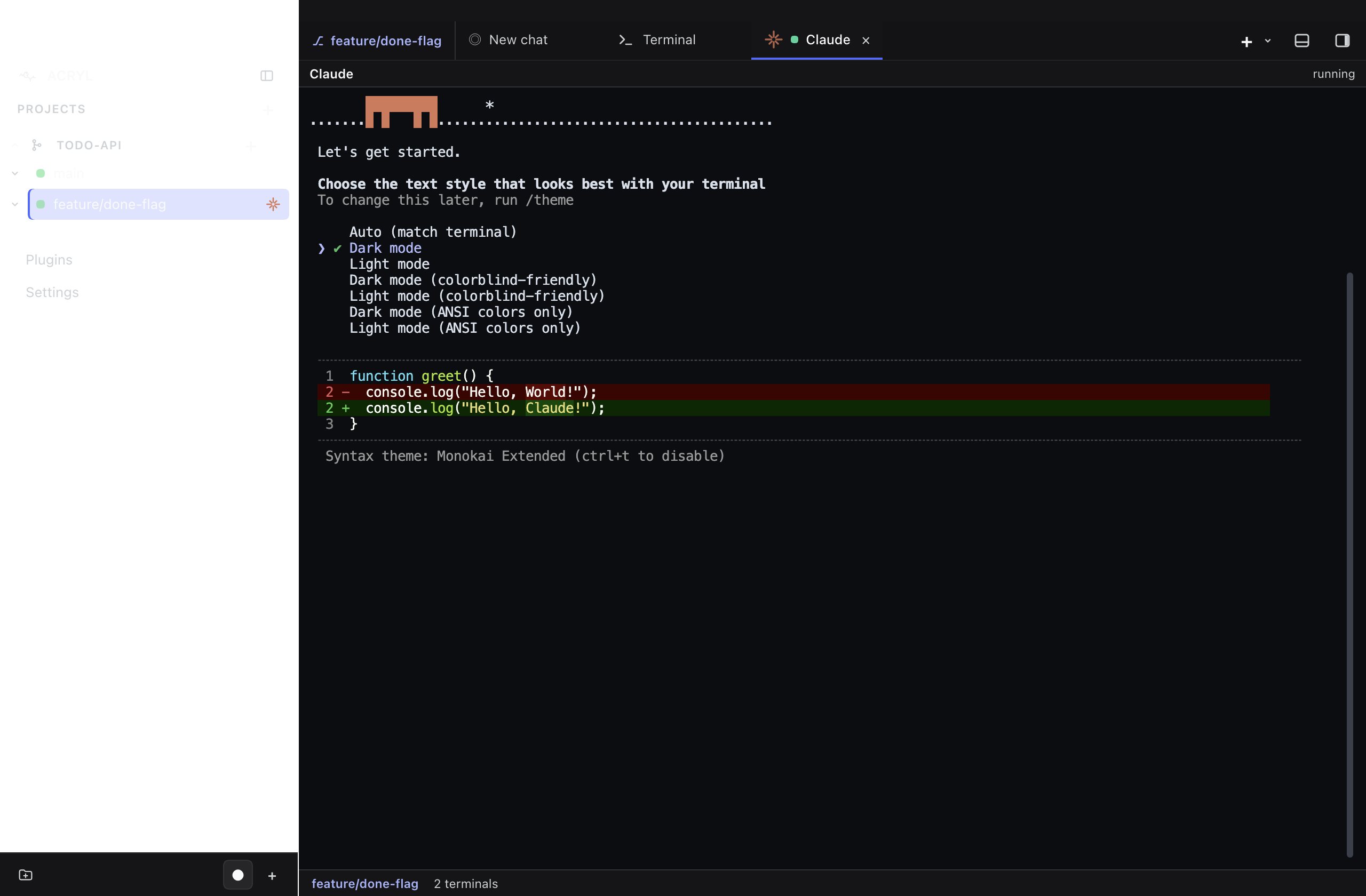
Projects, worktrees, every coding agent side by side.
One worktree per idea, any agent in it
- Projects and git worktrees in one tree; each branch gets its own chat
- Claude Code, Codex, Grok, Copilot, OpenCode, Pi and ACRYL's own agent as tabs
- Terminal, browser, file editor, diff, board and doc tabs
- Comment on a line, send it to the agent; review and commit in the right panel
- A shared brief every agent in the workspace reads
It builds itself
Ask for a feature your workflow lacks. It becomes a plugin, live.
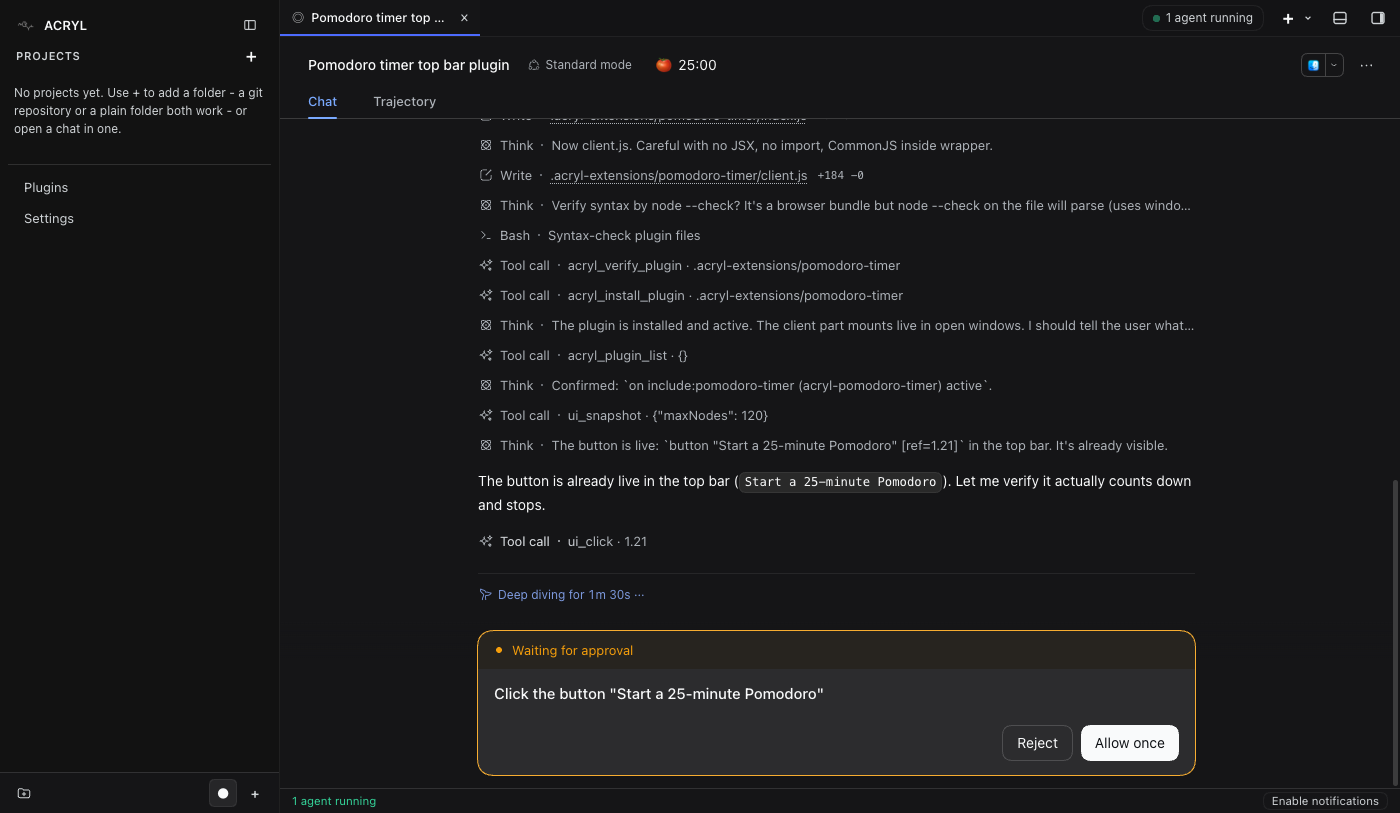
It reads ACRYL's plugin docs, writes the plugin, verifies and installs it, then clicks its own button to test it. In rehearsal it found an accessibility flaw in its own code and fixed it while the timer kept running.
Not a button this time: a tool the agent itself can call from now on. Made for your workflow in minutes, then shared through one registry so the next person pulls it instead of rebuilding it.
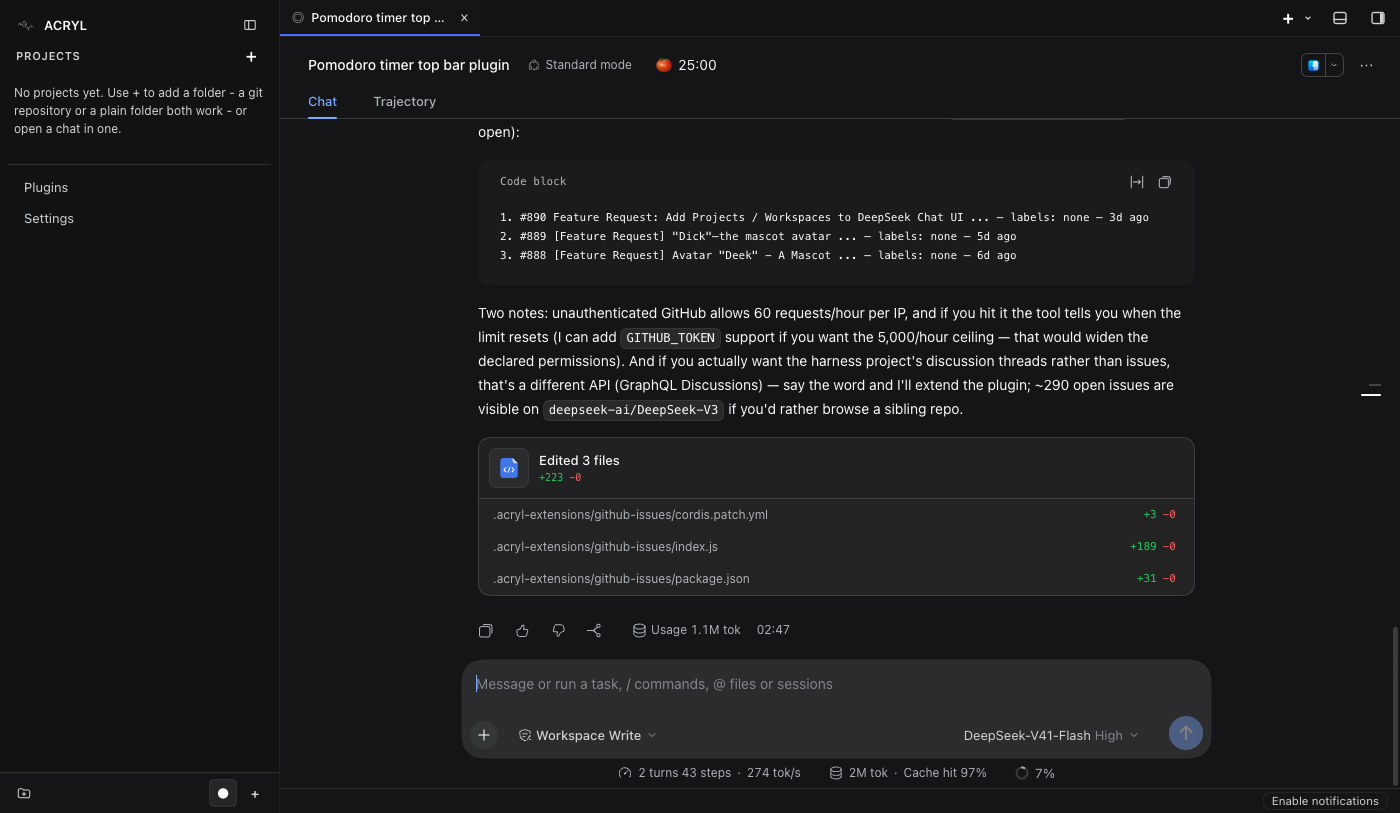
How it builds a plugin, live
package.json
Name, version, what it needs and provides.
index.js
Host side: services and tools for the agent.
client.js
UI side: fills a slot such as the header.
cordis.patch.yml
Where it sits in the app's composition.
Agentic apps,
any direction
Same framework. The agent operates the app, not only its code.
Getting Things Done
acryl.gtd
acryl new my-planner --from acryl.gtd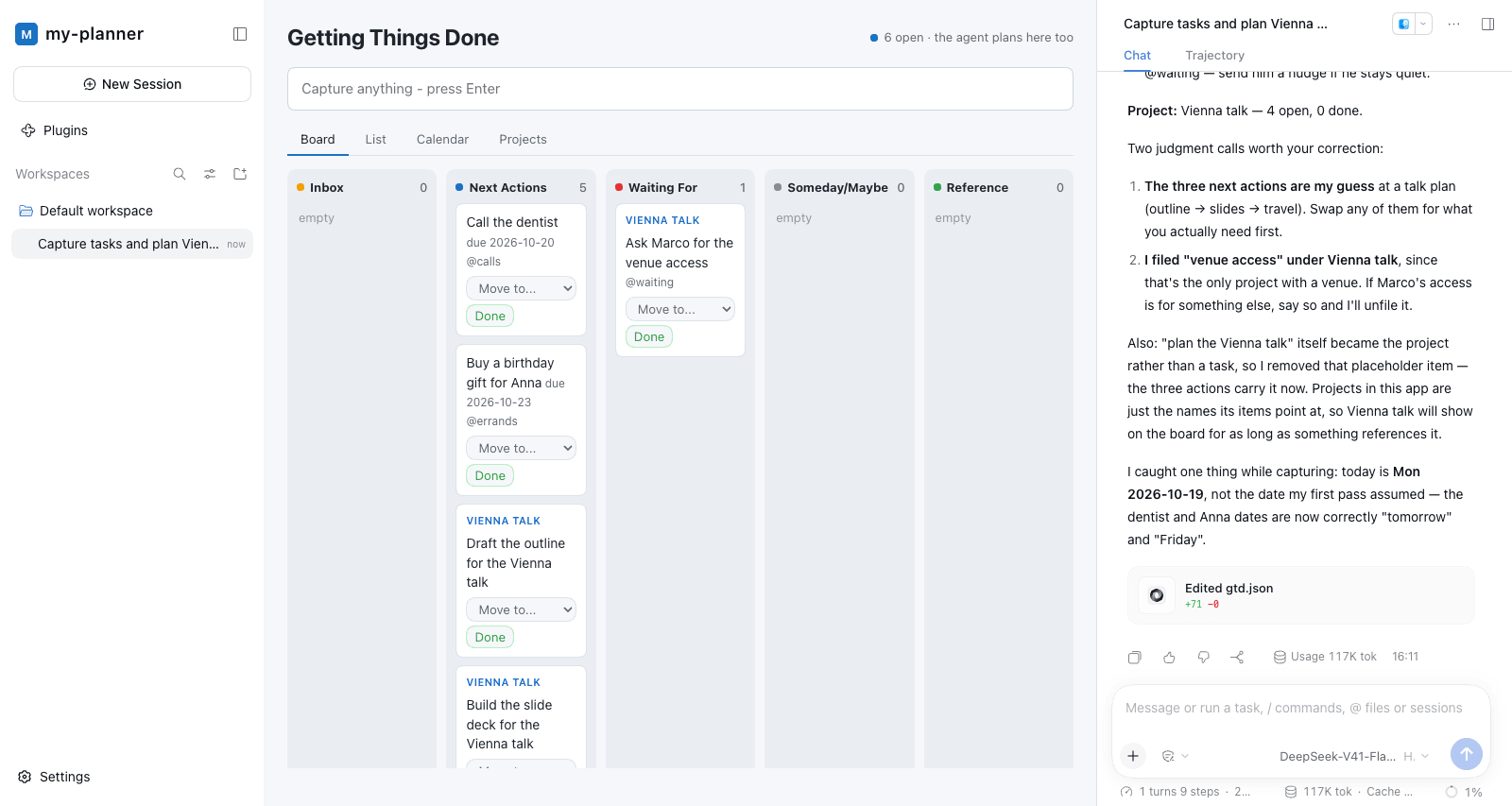
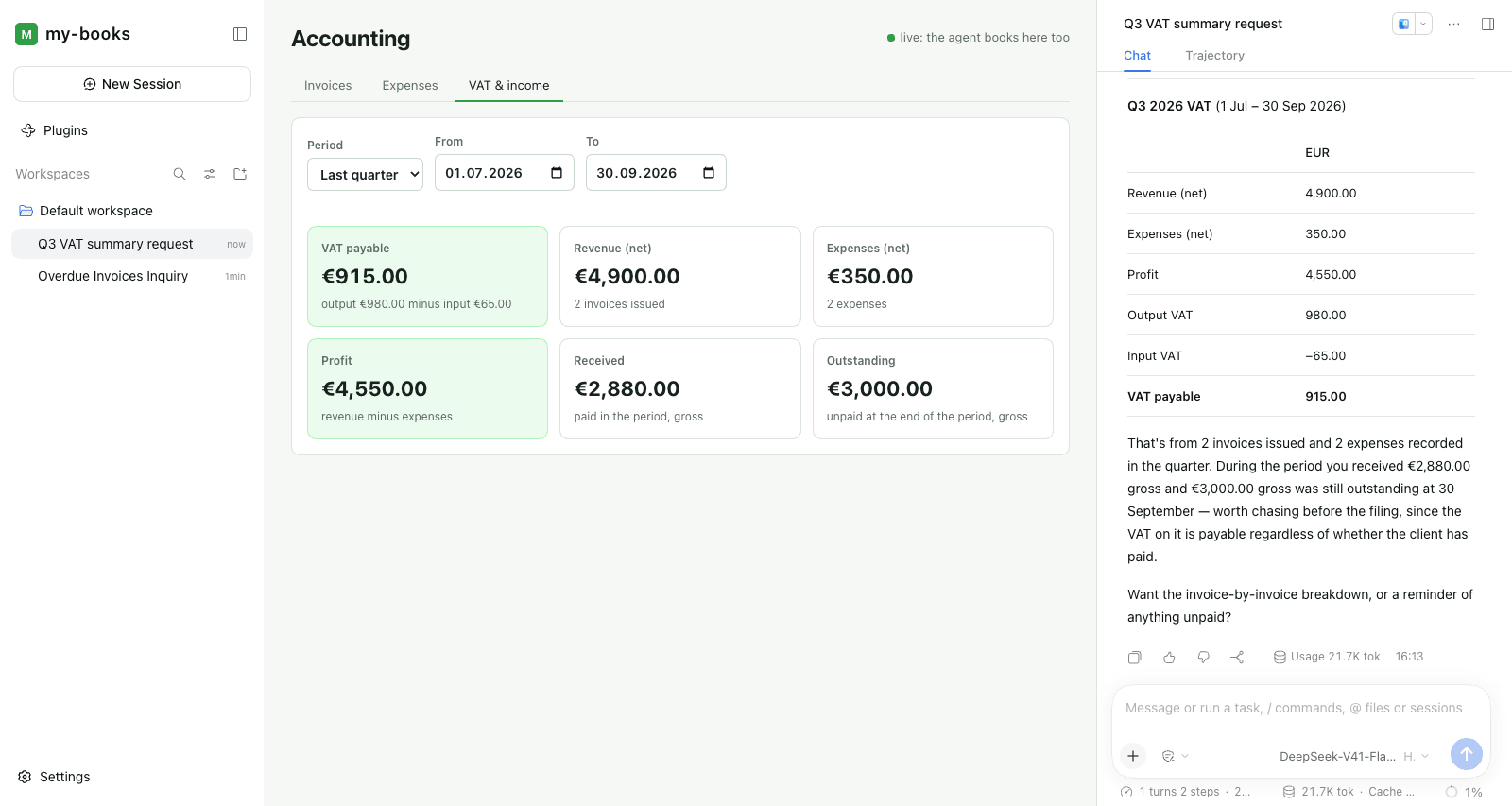
Invoices, expenses, VAT
acryl.accounting
Six agent tools over the app's own data. "Add a CSV export" makes it write a new plugin with its tests in about two minutes.
The drum machine is the app
acryl.music
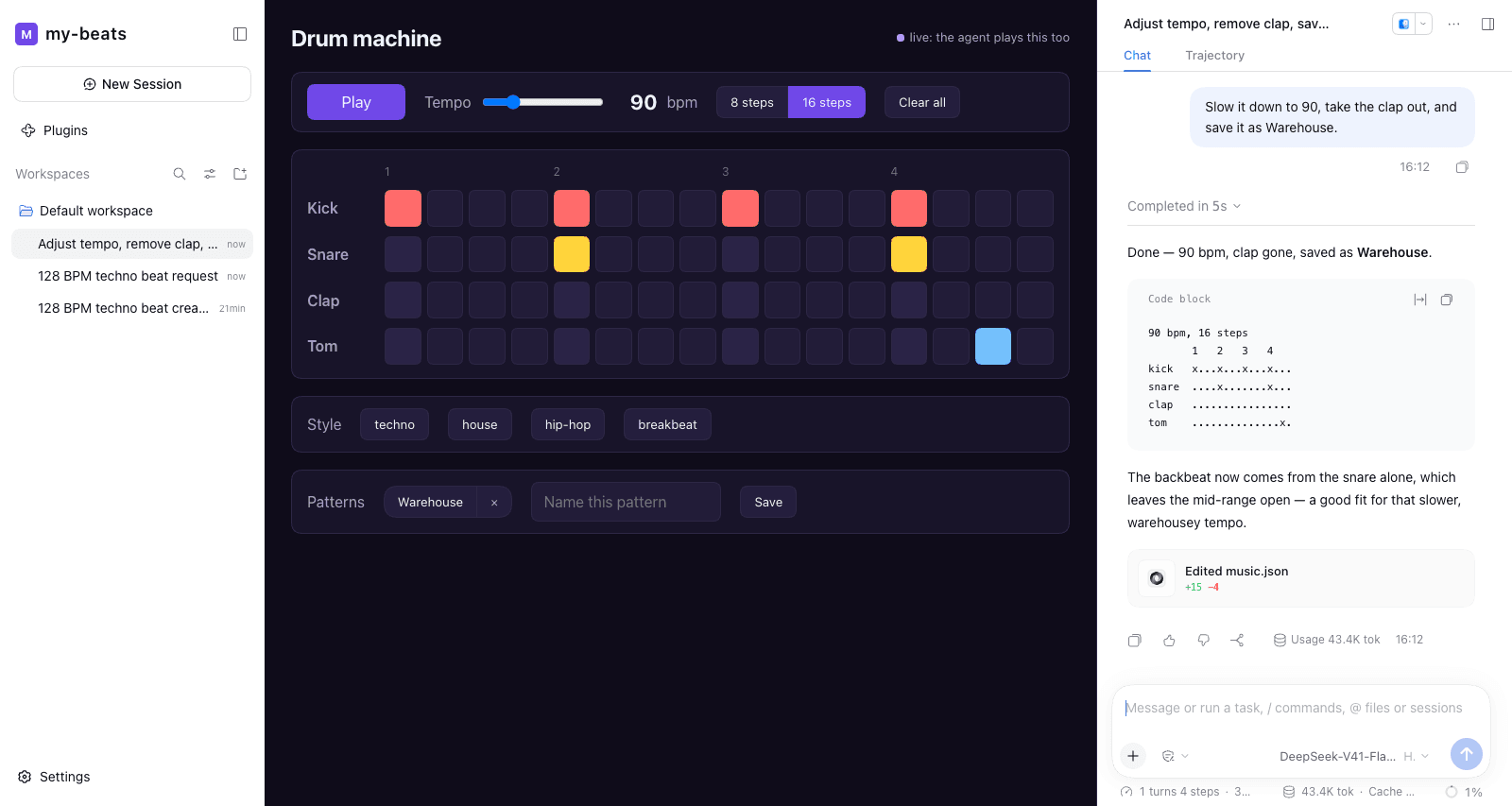
"Slow it down to 90, take the clap out, and save it as Warehouse." 5 s. No page to open: you start the app and it is a drum machine with an agent inside.
A drum machine the agent plays
acryl.music
This grid is a small copy running in the slide. Sounds are synthesized; nothing is downloaded.
Real ACRYL Blend apps, running
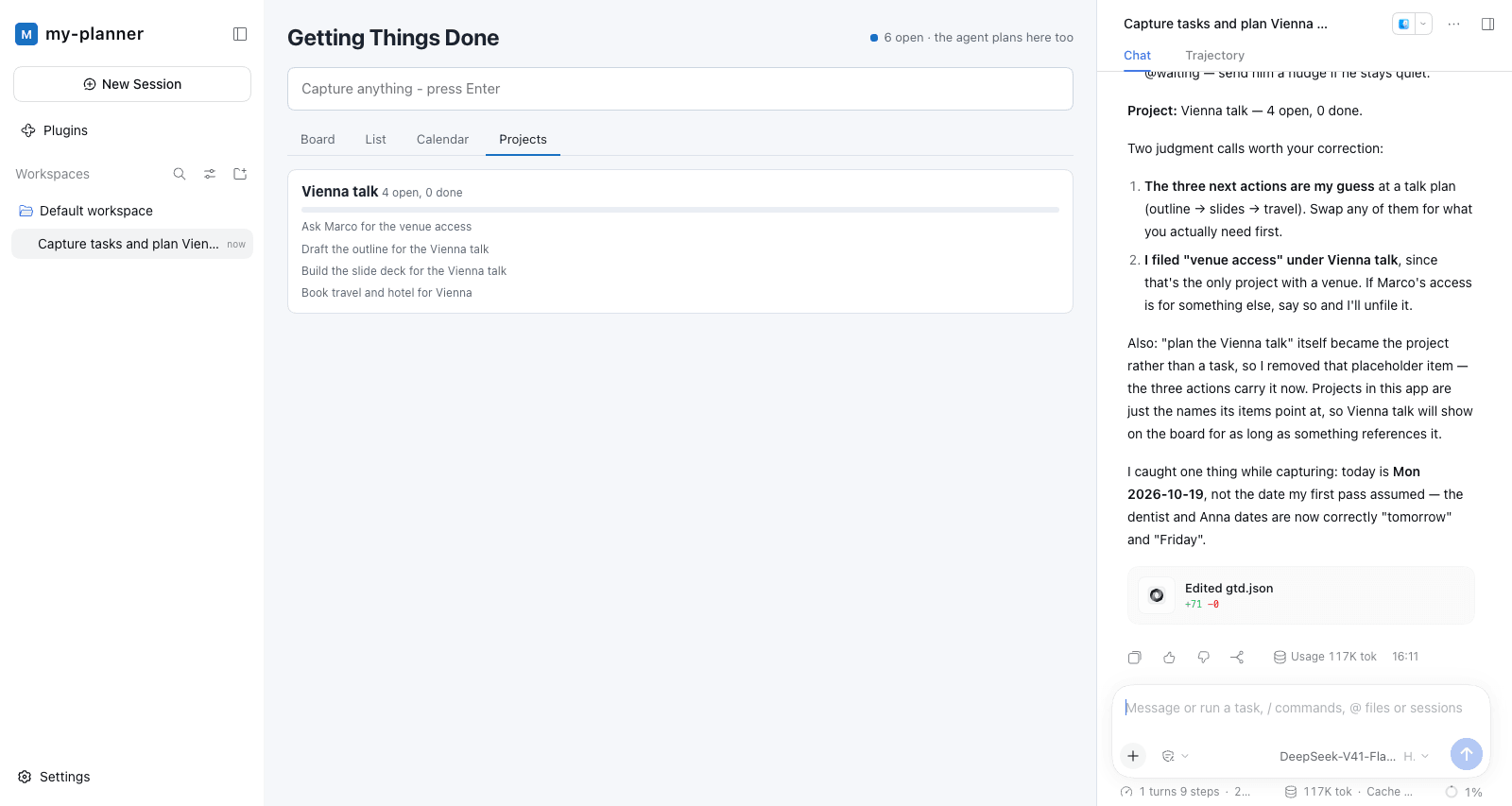
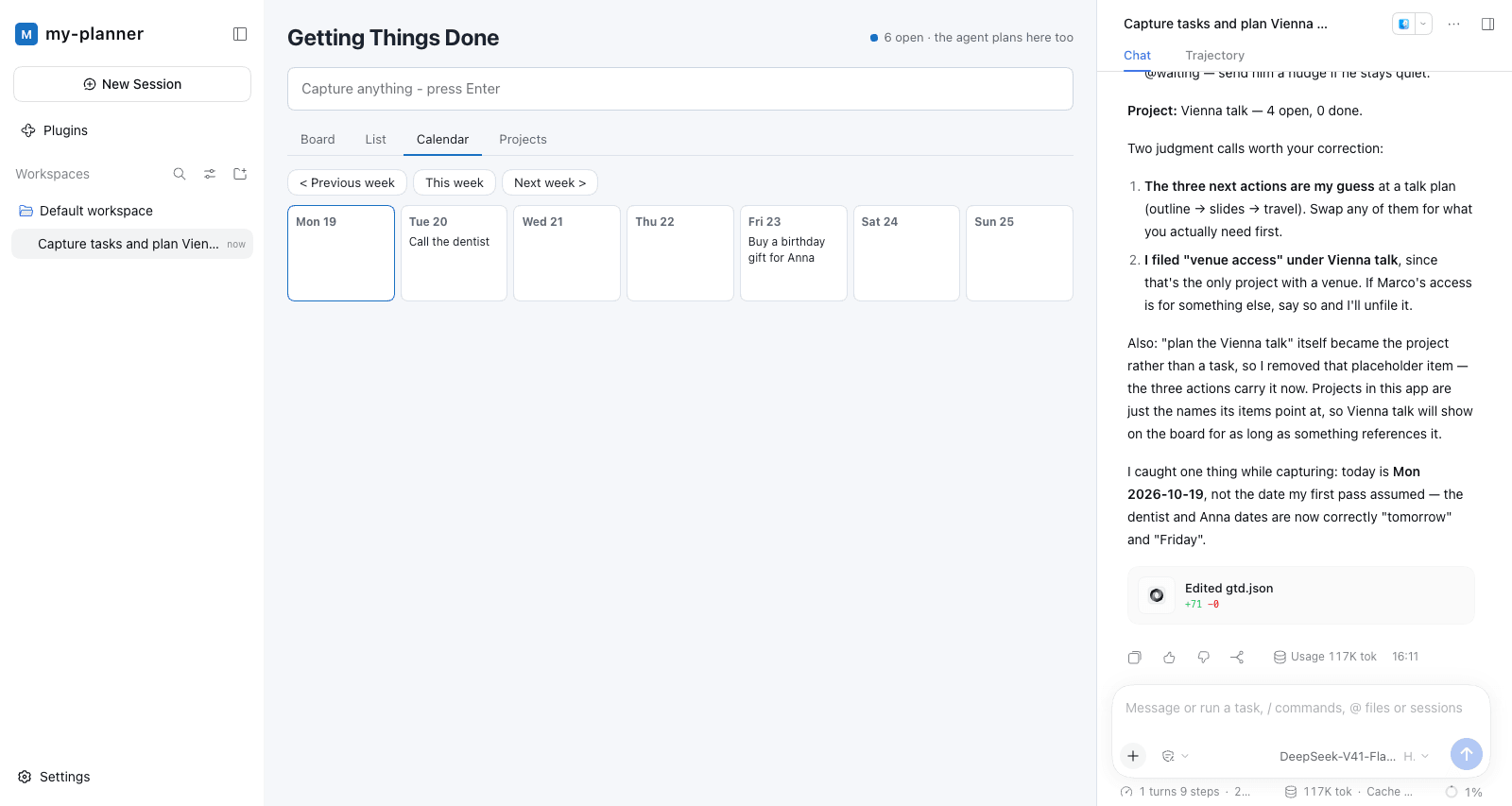
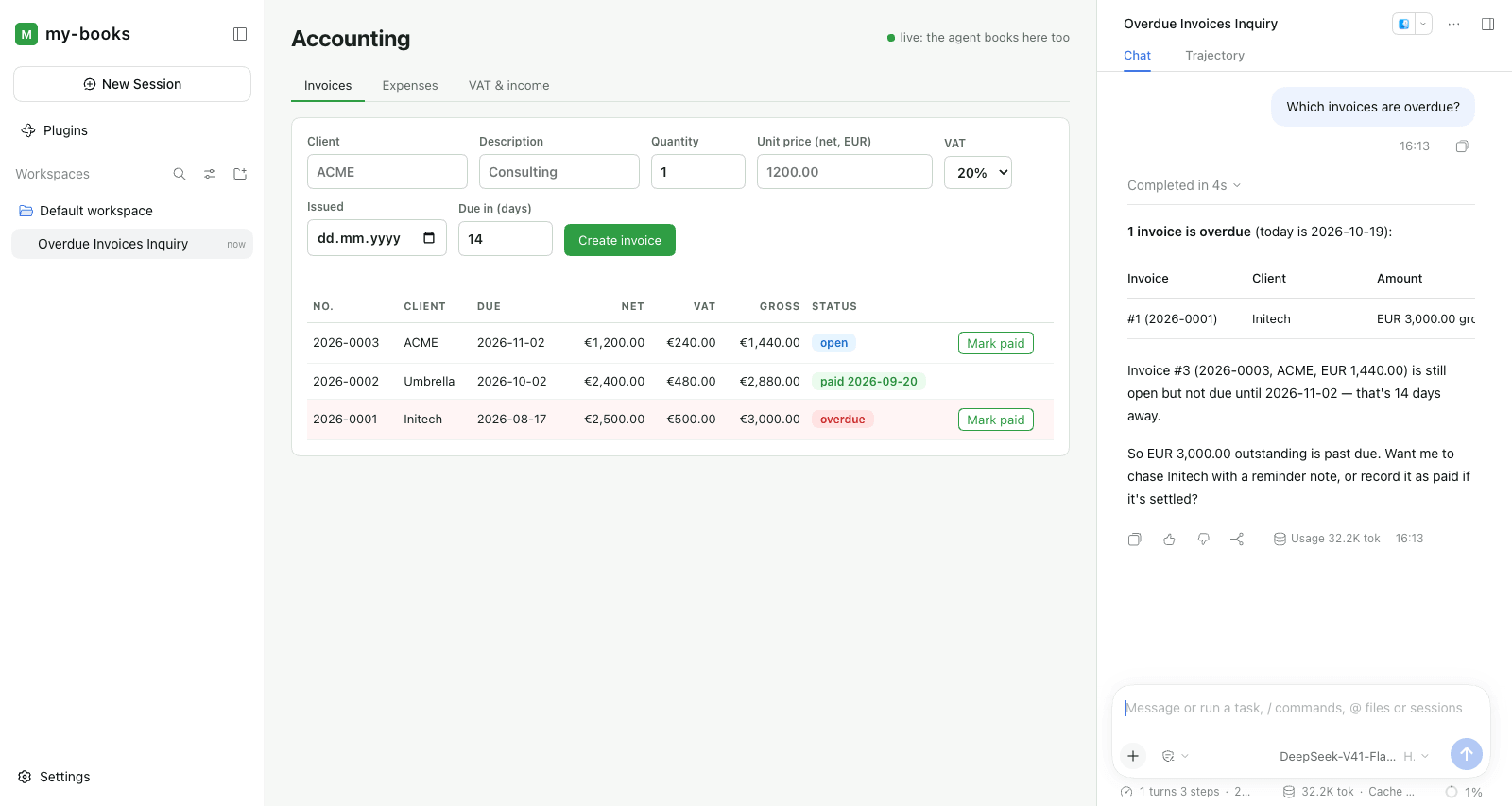
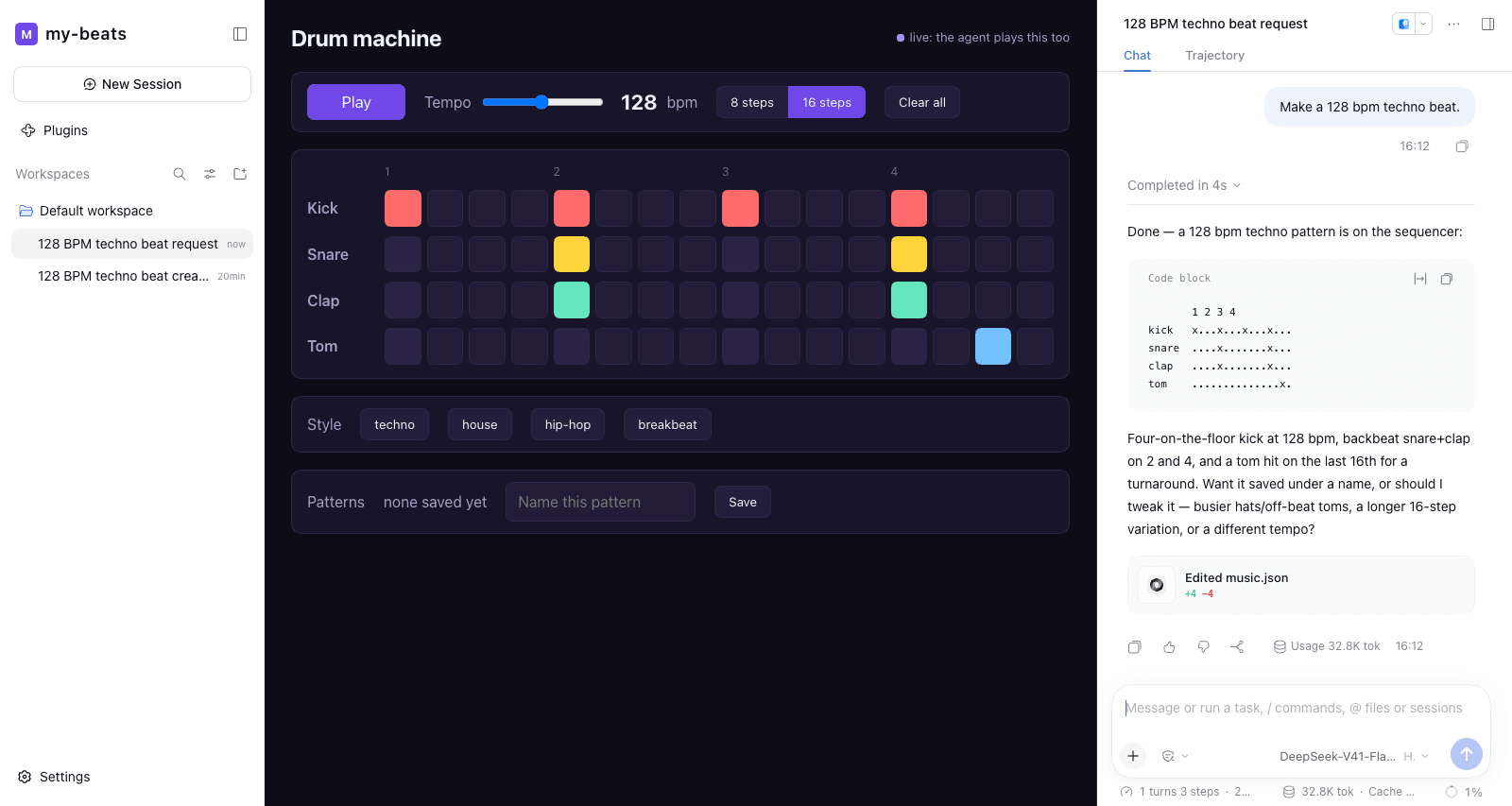
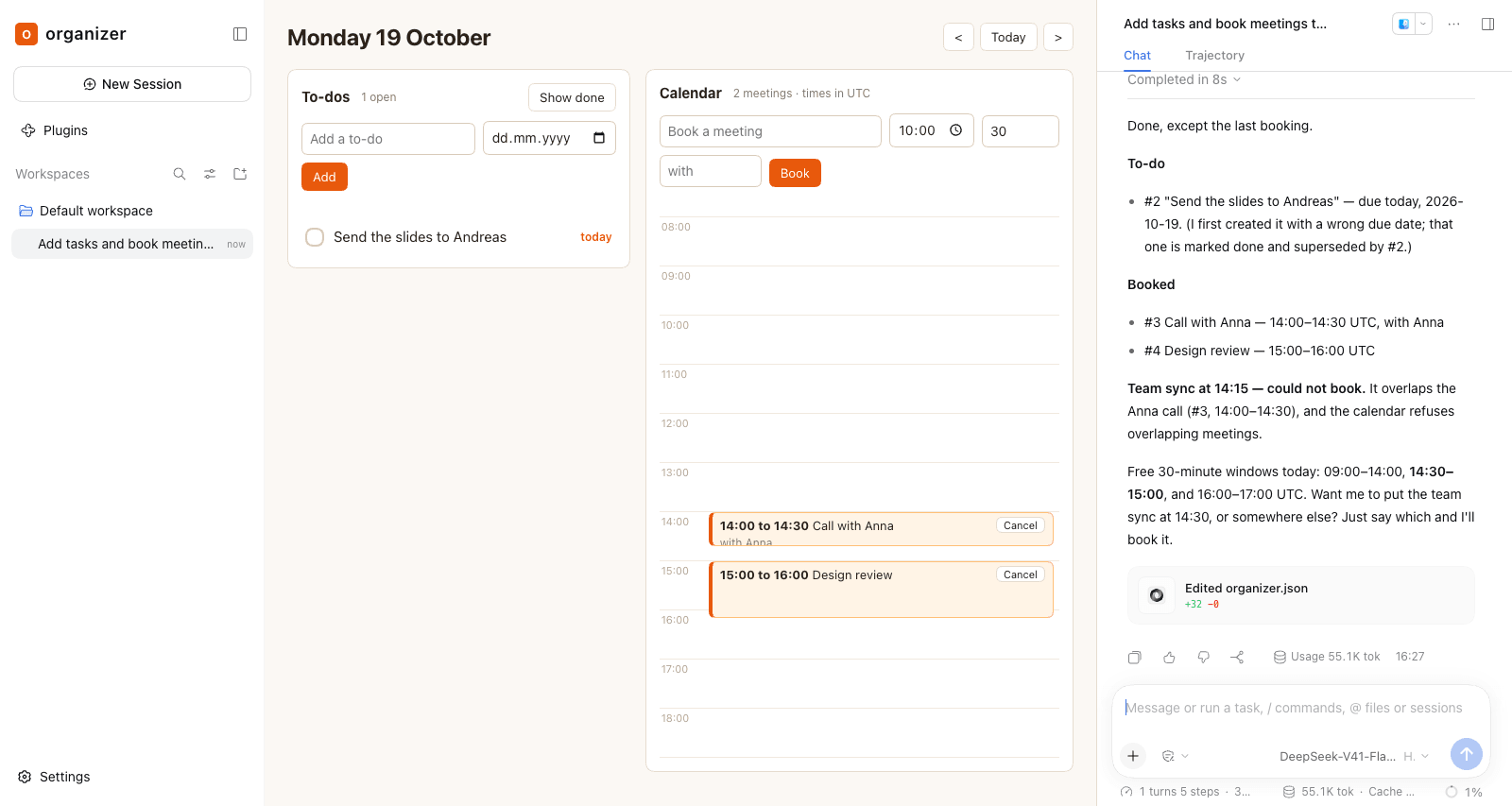
Every shot: an app made with acryl new --from from the public registry, run isolated with the real model on 2026-10-19. The window is the app; the agent sits beside it. Click any shot to enlarge.
Blends and plugins people can reuse
· Blends reading
· Cordis plugins reading
The life of a Blend
Snapshot it, clone it, it restores itself
/plugin pull github:inboxxobni/acryl-quick-notes@0.3.0/blend snapshotacryl new planner-copy --from ./my-planner{
"formatVersion": 3,
"origin": { "id": "app.my-planner", "kind": "Blend" },
"lineage": { "blueprint": "acryl.gtd", "blueprintVersion": "0.1.0" },
"parameters": {},
"rows": [ ... ],
"modules": [
{ "name": "acryl-quick-notes", "origin": "pulled",
"version": "0.3.0",
"spec": "github:inboxxobni/acryl-quick-notes@0.3.0",
"digest": "sha512-m9bN..." }
]
}A new agentic app in three seconds
npx acrylblends@0.2.0 init my-agent --agent --yescd my-agent && npm install && npm startcurl -X POST $URL/ask -H 'content-type: application/json' -d '{"question":"create route hello /hello Hello"}'curl $URL/helloThe app grows from inside: the agent adds a route as a plugin while the server runs. Node 22.19+, MIT, on npm and GitHub.
95 features, all real
macOS, Windows, Linux. Desktop, Web, terminal.
Desktop
Installers for macOS (Apple silicon, Intel), Windows 10 and 11, Ubuntu and Debian.
Web
The same app in your browser, from one command.
Terminal
A full terminal UI and CLI: npm install -g acryl
curl -fsSL https://acryl.dev/install | bashSoftware that evolves, built from parts that last
Self-evolving
The agent inside writes, tests and repairs the app's plugins as your use of it changes.
Composable
An app is a list of plugins in blend.yaml. Add, override or remove one without forking.
Stable
Every plugin is verified before it installs, pinned by version and checksum, reverted cleanly on failure.
Interoperable
Cordis plugins run in ACRYL and in stock DeepSeek Harness; one registry lists both.
Reusable
Share a plugin or a whole app; others pull it by name instead of rebuilding it.
Yours and open
Your machine, your data, your git. MIT, on GitHub and npm.
What we are building now
- next The Blends page: save, share, pull another Blend with a diff of every plugin change
- next Software factory: see every agent session on the machine, hand off in one click (moving work between Claude Code, Codex and Pi through the shared workspace brief works today)
- next Workflows that travel with a Blend: one main agent, workers in isolated worktrees, spec-driven
- next Settings and workspaces inside a Blend
Own your AI.

Alex Muzychenko · let's connect
linkedin.com/in/alexandermusichen · t.me/musichen · book a call: all0e.com/@alex
office@web-boxes.com · alex.musichen@gmail.com
Own Your AI #5 · Tuesday 20 October 2026 · IT-Services der Sozialversicherung, 1020 Wien · luma.com/2mxma8s0
npm: acryl, acrylblends · the whole talk on one page: acryl.dev/demo/ownmyai/spe